Corporate Giving Terms You Should Know: Nonprofit Glossary
In the dynamic world of nonprofit fundraising, corporations provide a consistent revenue stream that helps organizations achieve mission-critical revenue. However, a lack of awareness of these opportunities leaves more than $4-$7 billion in available funds on the table each year. Therefore, mastering common corporate giving terms is the first step toward unlocking significant revenue for your cause.
This comprehensive glossary provides an overview of all the essential vocabulary for workplace giving, helping nonprofit fundraisers and corporate social responsibility leaders navigate the technical landscape effectively. We’ll cover:
- Key Umbrella Terms
- Types of Giving Programs
- Software & Tech Tools
- Guidelines & Processes
- Other Kinds of Matches
Note: The language of corporate philanthropy can often feel like a barrier to entry for many nonprofit professionals. Our guide is designed to bridge that gap by providing clear, actionable definitions for the most important terms in the industry today.
Let’s dive right in!

Key Umbrella Terms
Corporate Social Responsibility
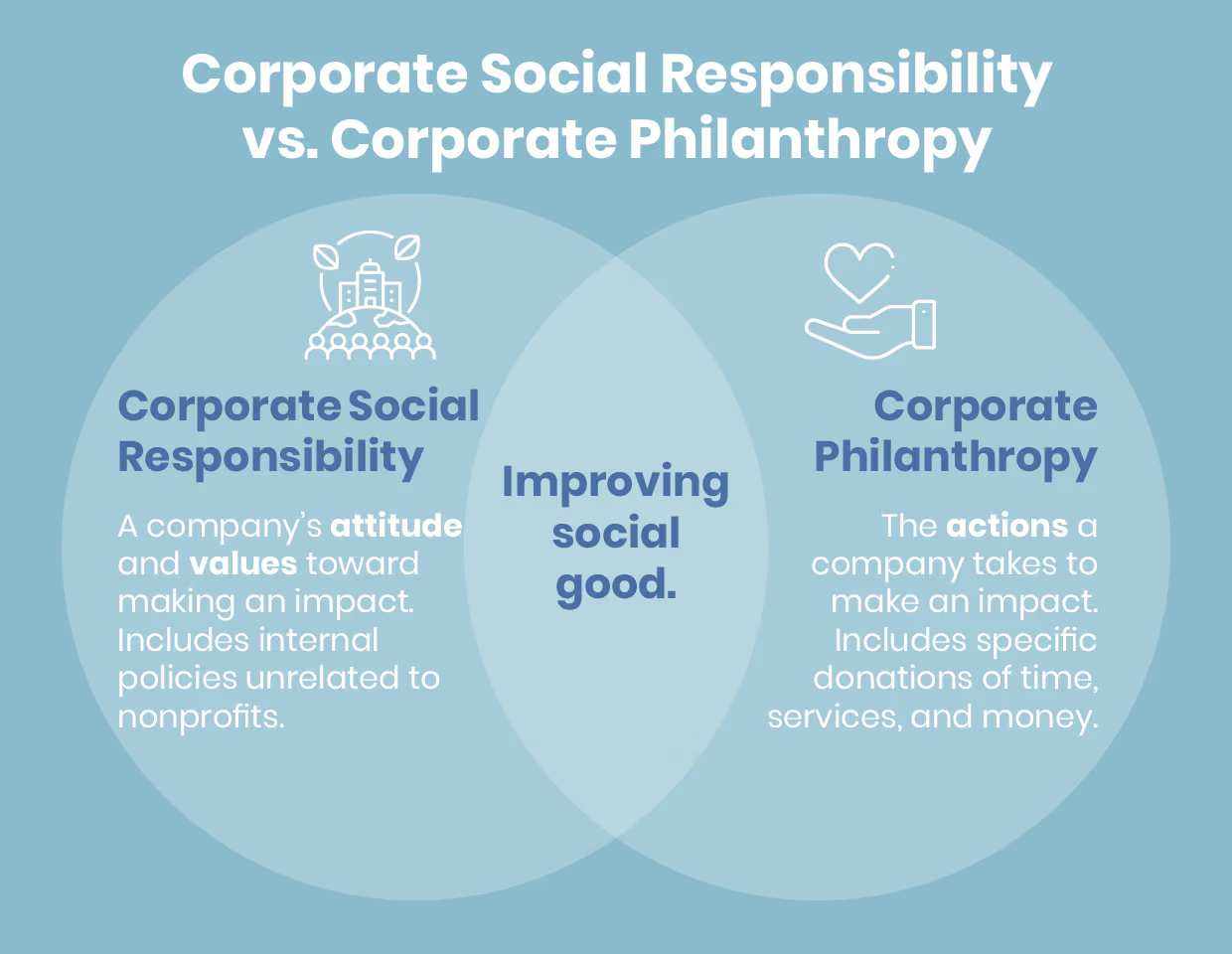
Corporate Social Responsibility is a business model that helps a company be socially accountable to itself, its stakeholders, and the public. By practicing social responsibility, also called CSR, companies can be more aware of the impact they have across economic, social, and environmental dimensions. It is a broad concept that can take many forms depending on the company and industry. Through CSR programs, philanthropy, and volunteer efforts, businesses can benefit society while boosting their own brands.
For nonprofits, understanding a company’s CSR strategy is essential because it dictates where its money and resources will be directed.
Corporate Philanthropy
Corporate philanthropy is the act of a corporation or business promoting the welfare of others, generally through charitable donations of funds or time. It is a broad term that covers everything from a small local business sponsoring a youth sports team to a multi-national corporation establishing a private foundation with a billion-dollar endowment.
While it is often used interchangeably with corporate social responsibility, philanthropy specifically refers to the outward giving of resources rather than internal business practices. For a nonprofit, this is the umbrella under which all corporate revenue streams sit.
Corporate Partnerships
Corporate partnerships are long-term, multi-faceted relationships between a company and a nonprofit organization that go beyond a single donation. These partnerships often involve a combination of financial support, employee engagement, and shared marketing efforts. A successful partnership is built on shared values and mutual goals, such as a multi-year commitment to improve local literacy rates. These relationships are the gold standard of fundraising because they provide stable, predictable support and allow both organizations to collaborate on large-scale social impact projects.
Corporate Giving Programs
Corporate giving programs refer to the specific initiatives a company uses to provide financial and non-financial support to nonprofit organizations. It is often seen as the practical application of a company’s philanthropic goals. These programs are designed to be mutually beneficial, helping the nonprofit achieve its mission while helping the company build its brand and engage its workforce. Corporate giving is highly structured and often managed by a dedicated community relations team that oversees the distribution of grants, employee matches, and in-kind resources.
Workplace Giving
See Also: Employee Giving
Workplace giving is the master category for all employer-sponsored initiatives designed to create social impact. It is a comprehensive suite of programs that leverages corporate resources, such as employee contributions, company capital, and professional expertise, to support nonprofits. This ecosystem is generally split into two models. Employee-driven programs include matching gifts and volunteer grants. Corporate-driven programs involve top-down decisions, such as institutional grants and sponsorships.
Types of Giving Programs
Matching Gifts
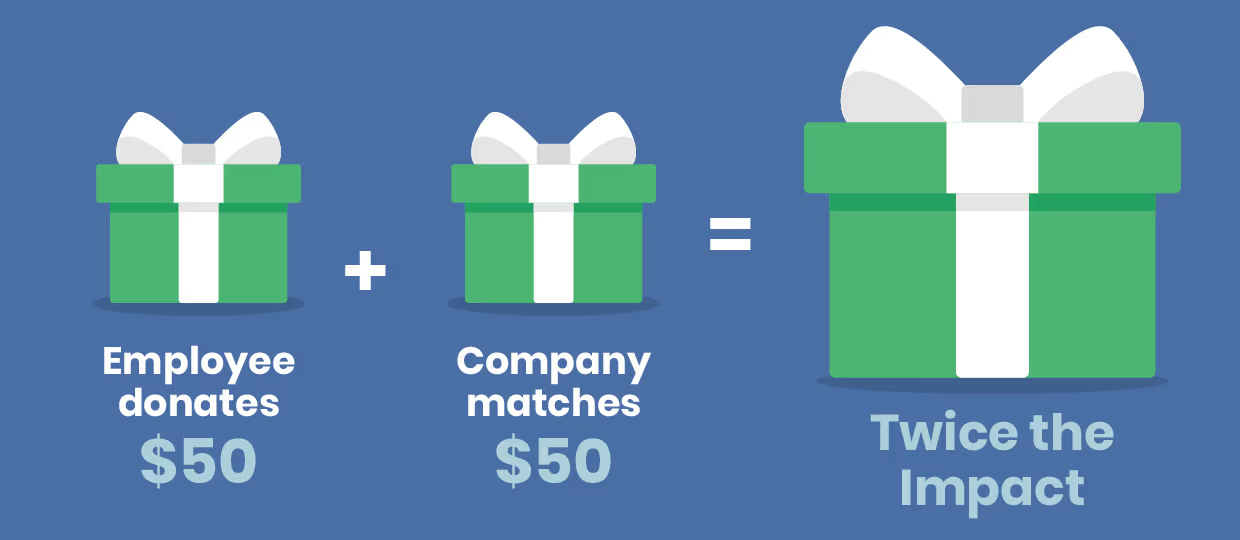
Matching gifts are a form of corporate philanthropy where companies match the charitable contributions made by their employees to nonprofits. These programs are the most common form of workplace giving and provide a simple way for donors to double the impact of their gifts.
Over 26 million individuals work for companies with matching gift programs, yet billions of dollars go unclaimed every year. This gap is primarily due to a lack of donor awareness, making it essential for nonprofits to promote these opportunities during the donation process.
Volunteer Grants
See Also: Dollars for Doers
Volunteer grants are monetary contributions given to nonprofits in recognition of an employee’s volunteer hours. These programs allow employees to turn their time into cash for the organizations they support. A volunteer typically must reach a certain hour threshold, such as 20 hours in a year, before the company issues a grant. This program is a powerful way for nonprofits to increase the return on investment of their volunteer programs.

Volunteer Time Off
Paid volunteer time off (VTO) is a type of corporate policy that allows employees to volunteer during regular work hours while still receiving their full salary. This benefit removes the time barriers that often prevent professionals from engaging in community service.
For nonprofits, VTO provides a consistent and reliable stream of skilled labor. It also serves as a powerful recruitment and retention tool for companies, as modern employees increasingly seek workplaces that value social responsibility and community engagement.
Payroll Giving
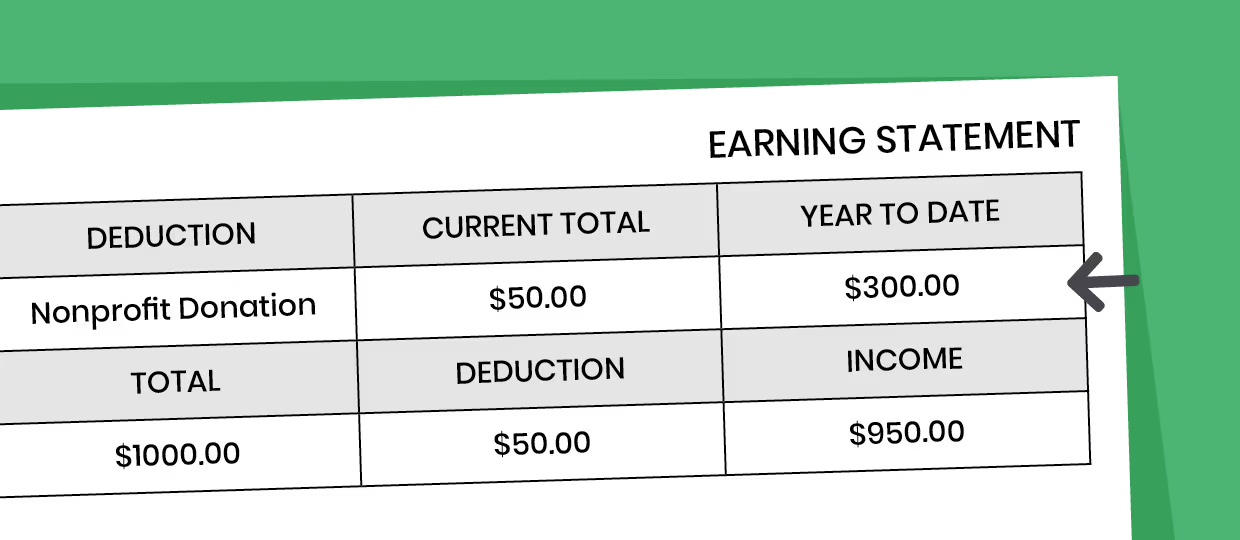
Payroll giving is a fundraising method in which employees donate to a nonprofit directly from their paychecks. This program is a gateway to predictable, recurring income for nonprofits and improved donor retention. Once a donor signs up, the deduction is processed each pay period automatically, reducing administrative effort for the individual. The company typically partners with a payroll giving platform to manage the deductions and ensure the funds are routed correctly to the chosen charity.
Fundraising Matches
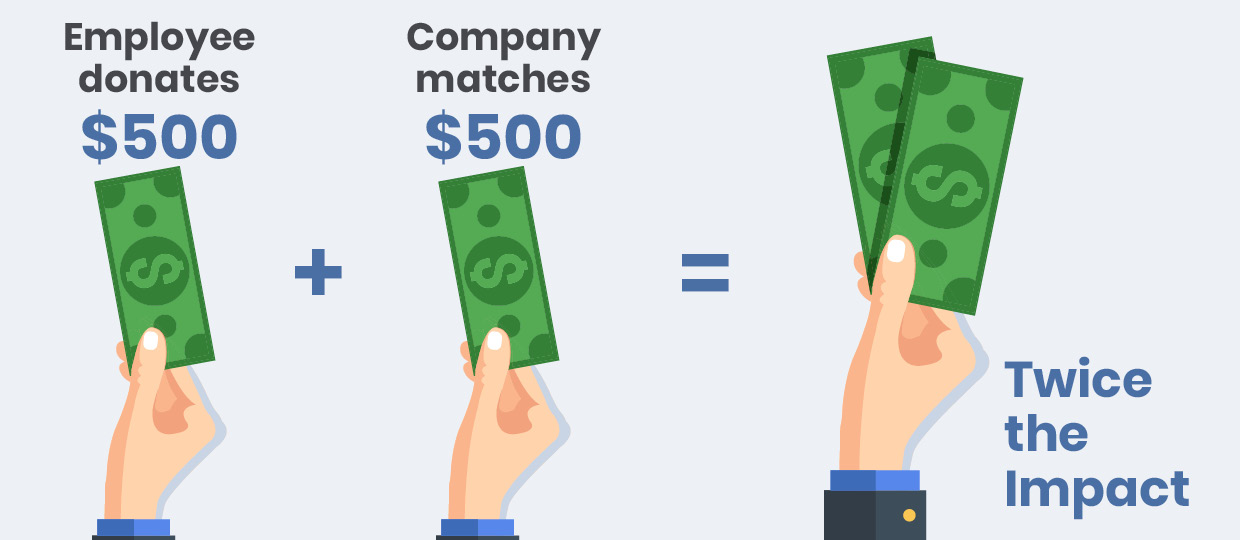
Fundraising matches are a specialized type of matching gift in which a company matches the total funds an employee raises through a peer-to-peer fundraiser. This is often used for walkathons, marathons, or internal company fundraising competitions. For example, if an employee raises $500 from friends and family for a charity run, their employer might provide a $500 Fundraising Match to reward their advocacy. These programs are powerful because they incentivize employees to become active ambassadors for your mission within their personal networks.
Corporate Sponsorships
Corporate sponsorships are a form of corporate partnership in which a company provides financial support for a specific event, program, or project in exchange for marketing visibility. This is common for gala dinners, 5K runs, or community festivals. The company receives brand recognition through logo placement on event materials, social media mentions, and on-site signage.
Unlike most grants, sponsorships are often funded through a company’s marketing or public relations budget rather than a philanthropic foundation, as the primary goal is often brand alignment and community visibility.
Corporate Grants
Corporate grants are financial contributions made directly by a business or its corporate foundation to a nonprofit organization. Unlike matching gifts and other workplace giving contributions, which are triggered by individual employees, corporate grants are usually awarded through a formal application process. They are often intended to support specific programs or projects, or general operating costs, that align with the company’s business values and social impact goals. As a result, these are typically larger, one-time or multi-year commitments that require detailed reporting and outcomes.
In-Kind Donations
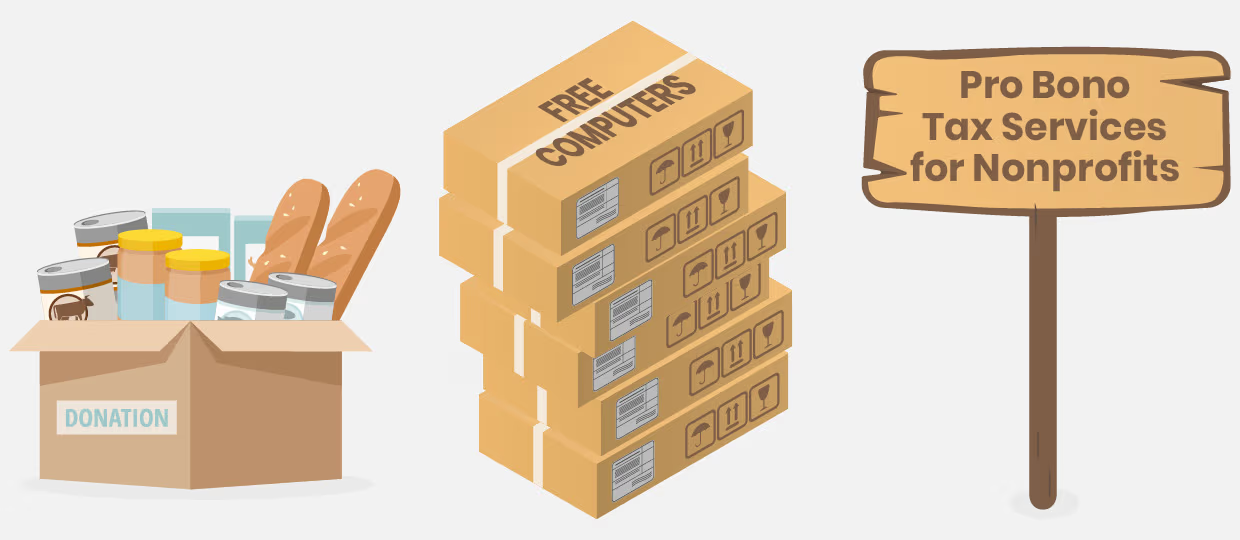
In-kind donations are non-monetary gifts of goods or services provided by a company to a nonprofit. These contributions are valued at their fair market value for accounting and tax purposes. Common examples include a tech company donating laptops to a school or a moving company providing free transportation for a nonprofit’s office relocation. These donations allow companies to support causes using their existing inventory or business assets rather than cash reserves.
Skills-Based Volunteerism
See Also: Pro Bono Work
Skills-based volunteerism is a form of service where employees use their professional expertise to support a nonprofit, and it’s also a subset of in-kind giving. This often involves tasks like legal counsel, marketing strategy, or IT consulting. The economic value of these services is often much higher than that of general manual labor. By engaging in skills-based volunteerism, corporations can provide high-impact support that helps nonprofits build internal capacity and solve complex organizational challenges.
Product Philanthropy
Product philanthropy is a specific type of in-kind giving in which a company donates its own manufactured goods directly to a nonprofit (often to be distributed to beneficiaries or sold at auction). This is common in the pharmaceutical, apparel, and software industries. For example, a clothing brand might donate surplus inventory to a disaster relief organization, while a technology company may provide laptops to an underfunded STEM program.
Product philanthropy helps companies manage their supply chains sustainably while providing essential resources to organizations in need. It often requires specific logistics and distribution capabilities from the nonprofit partner.
Software & Tech Tools
Workplace Fundraising Automation Platforms
Workplace fundraising automation software is a suite of tools that nonprofits use to identify, track, and automate their corporate fundraising efforts. This technology, provided by platforms like Double the Donation, helps organizations find match-eligible donors and provides them with the necessary forms and instructions to complete their requests. By automating the outreach and follow-up process, this software enables development teams to increase revenue without increasing manual workload, ensuring no corporate dollar is left behind.
Matching Gift Software
Matching gift software is a specific subset of workplace fundraising tools that nonprofits use to identify, track, and automate their corporate fundraising efforts. This technology is designed to help organizations find match-eligible donors and provide them with the necessary forms and instructions to complete their requests.
By automating the outreach and follow-up process, matching gift software like Double the Donation Matching allows development teams to grow their revenue without increasing their manual workload. It is the essential technical layer that ensures no corporate dollar is left behind during the donation process.
Workplace Giving Software Integrations
Workplace giving software integrations are ready-built technical connections that link a nonprofit’s fundraising suite to its other essential digital tools. By using these integrations, donation forms, peer-to-peer software, CRMs, and volunteer management systems can all be connected to a central workplace fundraising platform like Double the Donation. This connectivity streamlines the flow of employment data and gift records across the entire organization. When these systems are integrated, they automate time-consuming processes like identifying match eligibility and triggering follow-up emails, ensuring that every opportunity for corporate revenue is captured with zero manual effort.
CSR Vendors
CSR vendors are third-party software companies that corporations hire to manage their social responsibility programs. Platforms like Benevity, YourCause, and CyberGrants serve as technical intermediaries in the giving process. The CSR vendor processes the final match request, and corporate funds are ultimately disbursed to the nonprofit. Understanding which vendor a company uses can help you navigate their specific submission portals.
Auto-Submission Functionality
Matching gift auto-submission is a modern technology that allows donors to submit their matching gift requests directly from a nonprofit’s donation form. By using tools like Double the Donation, donors can opt in to have their match request sent to their employer without ever leaving the nonprofit’s website.
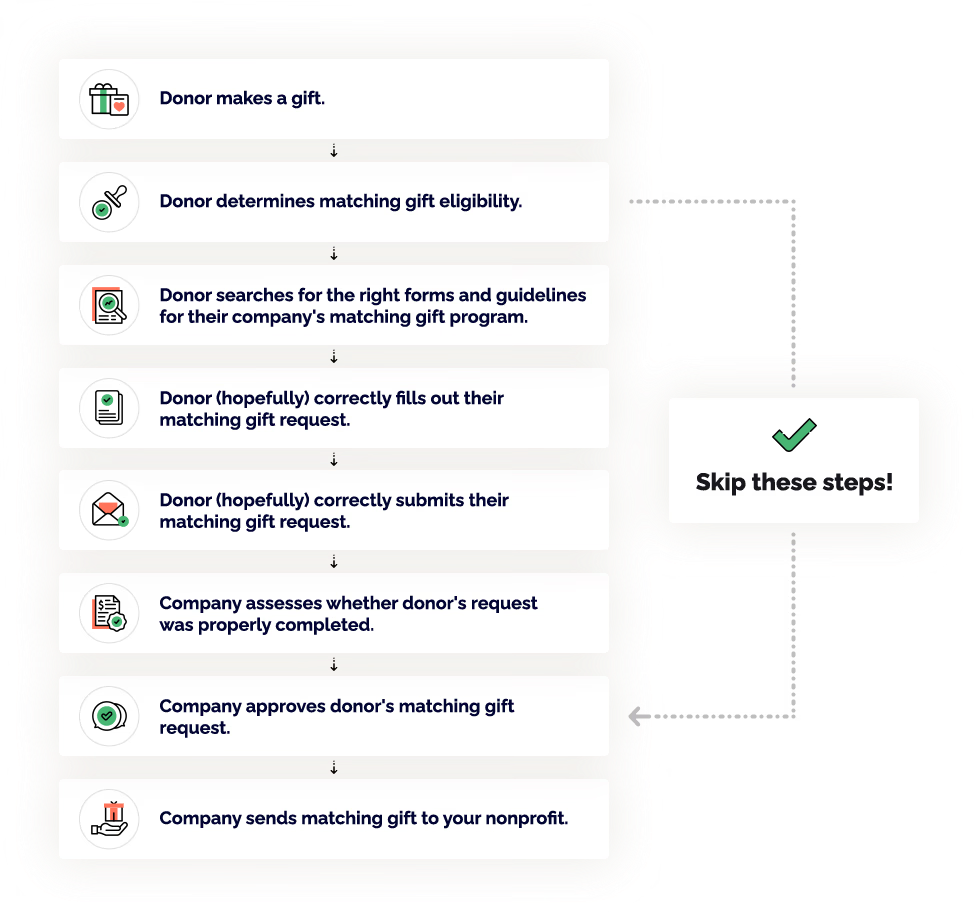
This removes the friction of visiting a separate corporate portal, where most matching gift requests are lost. This technology is the gold standard for maximizing workplace giving conversion rates.
 Certified Leader in Matching Automation (CLMA)
Certified Leader in Matching Automation (CLMA) is a designation awarded to companies that have prioritized the donor experience by enabling auto-submission technology. When a company is CLMA-certified, it means they have integrated their system with tools like Double the Donation, allowing employees to submit match requests instantly. This eliminates the need for the employee to visit a separate corporate portal after they give. For a nonprofit, identifying CLMA companies in your donor database is vital because these donors have a significantly higher match completion rate due to the frictionless submission process.
Guidelines & Processes
Employment Data
Employment data refers to the specific information a nonprofit collects about a donor’s or volunteer’s place of work, job title, and professional email address. This insight is the engine that powers a successful workplace giving strategy. Without accurate employment data, it’s impossible for an organization to identify which donors are eligible for matching gifts or volunteer grants.
Modern fundraising teams use search tools and email domain screening to source this information and add it to their donor records. High-quality employment data allows for personalized outreach that guides the donor to their specific corporate giving portal, increasing the likelihood of a successful request.
Matching Gift Ratio
A matching gift ratio is the multiplier applied to an employee donation to determine the corporate portion of the gift. It is a core component of the logic of any matching program and serves as an incentive for donor participation. While a 1:1 ratio is the most common industry standard, some standout companies offer 2:1 or even 3:1 matches. A higher ratio significantly increases the total value of a single donation and has been shown to increase donor response rates by over 70 percent.
Minimum and Maximum Thresholds
Minimum and maximum thresholds are the financial boundaries that define a matching gift program within its company-issued guidelines. A minimum threshold is the smallest donation amount a company will match, typically around $25. Meanwhile, the maximum threshold is the total dollar amount a company will contribute per employee in a calendar year. Once an employee hits their annual cap, any further donations they make will not be matched until the next fiscal year. Nonprofits must track these limits to accurately project their matching gift revenue.
Philanthropic Pillars
Philanthropic pillars are the specific social or environmental issues that a corporation prioritizes in its giving strategy. These pillars act as a filter for corporate grantmaking and sponsorship decisions. A tech company might have pillars focused on STEM education and digital equity, while a grocery chain might focus on food security and sustainable agriculture.
Nonprofits should research a company’s pillars before applying for a grant or sponsorship to ensure their mission aligns with the corporation’s strategic focus.
NTEE Codes
The National Taxonomy of Exempt Entities is a classification system used by the IRS to categorize nonprofits based on their primary purpose. CSR vendors often use these codes as technical filters to automate eligibility for corporate giving programs. If a company only supports environmental causes, its system might automatically decline any match request for a nonprofit with an education-related NTEE code. Ensuring your organization’s code is accurate is vital for passing these automated system checks.
Lump Sum Disbursement
A lump-sum disbursement is the combined payment of multiple individual employee donations to a nonprofit, sent by an employer or CSR vendor. To reduce overhead, companies do not send individual checks for every small payroll deduction. Instead, they aggregate all staff donations for a specific period, such as a month or a quarter, and send a single large payment. This process is more efficient for the nonprofit’s accounting team, though it requires careful reconciliation of the accompanying donor reports.
Pre-Tax vs. After-Tax Contributions
Payroll donations can be categorized as pre-tax or after-tax contributions based on how they affect an employee’s taxable income. Pre-tax donations are deducted from gross pay before taxes are calculated, reducing the employee’s tax liability and making their gift more cost-effective. After-tax donations are deducted, so in many regions, pre-tax giving is a major incentive for employees to participate in payroll giving schemes because it simplifies the tax-benefit process.
Letter of Inquiry
A letter of inquiry (LOI) is a brief document submitted by a nonprofit to a corporate funder to gauge interest in a project before preparing a full grant proposal or application. It serves as a pre-screening tool, allowing grant officers to filter out projects that do not align with their current philanthropic pillars.
An LOI typically includes a summary of the nonprofit, the problem it addresses, and the requested funding amount. If the company is interested, they will invite the nonprofit to submit a formal application.
Matching Gift Reconciliation
Matching gift reconciliation is the accounting process of matching incoming corporate checks to the original employee donations. Since companies often send lump-sum payments, nonprofits must verify which employee triggered each portion of the check. This process ensures that donor records are accurate and that matching gift revenue is attributed correctly. Failing to perform this reconciliation can lead to data errors in your donor database. It is a critical step for maintaining financial integrity in workplace giving programs.
Matching Gift Centralization
Matching gift centralization, or unification, is a strategic approach to matching gift processing in which a large organization manages all its matching gift activity through a single department or software instance. Instead of individual chapters or branches handling matches, the central office oversees the identification and verification of gifts. This model ensures consistency in how matching gifts are marketed and tracked. It also allows the organization to negotiate better partnerships with corporations.
Centralized processing often relies on Double the Donation to manage the high volume of requests across different locations.
Key Performance Indicators
Key performance indicators are metrics used to evaluate the success and efficiency of a workplace giving program. Important KPIs for nonprofits include the matching gift rate, which tracks how many eligible donors actually submit a request, as well as total revenue from payroll giving.
For corporations, a primary KPI is the employee participation rate. Tracking these numbers allows both parties to identify areas for improvement and prove the return on investment of their philanthropic efforts.
Other Kinds of Matches
Challenge Matches
A challenge match is a high-urgency fundraising campaign where a company or other major donor pledges to give a specific amount if the nonprofit meets a predefined objective. These goals often focus on reaching a specific dollar amount or a number of new donors within a short timeframe.
Challenge match campaigns are designed to create momentum and excitement, encouraging the general public to give by showing them that their donation will have a guaranteed, amplified impact.
Matching Pool
The matching pool is the total amount of money set aside by a corporation or donor for a specific challenge match campaign. Once this pool is exhausted, the match is no longer available to the public. For example, a bank might provide a 50,000 dollar matching pool for a local food drive. Every dollar donated by the community is matched 1:1 until the full 50,000 dollars has been committed. This creates a sense of urgency for donors to act before the funds run out.
Time-Bound Window
A time-bound window is the specific start and end date during which donations must be made to qualify for a challenge match. This temporal constraint is designed to force a surge in fundraising activity and generate a sense of fomo among supporters. Gifts made before or after this window do not count toward the challenge goal or pull from the matching pool. These windows are common during events like Giving Tuesday or year-end campaigns.
Wrapping Up + Additional Resources
Corporate philanthropy is an increasingly valuable asset for nonprofit fundraisers. By growing associated knowledge across your team, you can set your organization up for continued success.
Interested in learning even more? Check out these recommended resources:
- The Ultimate Guide to Corporate Giving Trends. Explore more important workplace giving trends that can impact corporate giving efforts in this complete guide.
- 16 Impactful CSR Statistics Your Team Should Know. Want to learn more about the overall state of CSR and leverage data-driven insights? This resource is for you!
- Developing a Workplace Giving Plan: Free Download. Find out how to put these new ideas into action! Download Double the Donation’s free eBook that will walk you through building out a strategy for your organization.