
Beyond a 1:1 Match: Why the Future of CSR is Multiplier-Driven
In the world of Corporate Social Responsibility, the “standard” has long been defined by the 1:1 matching gift. It’s a clean, easy-to-understand model: an employee gives a dollar, and the company gives a dollar in return. For decades, this has been the benchmark of a good corporate citizen. But as we navigate the future of CSR and enter an era of heightened social consciousness, “good” is no longer enough.
The landscape of corporate philanthropy is shifting away from simple participation toward radical impact. Forward-thinking companies are realizing that to truly move the needle on global issues and to genuinely engage their workforce, they must move beyond the 1:1 ratio and embrace the power of the high-ratio matching gift.
And we’re here to help guide you through the process! In this guide, we’ll cover:
- The Psychology of the Multiplier: Why Match Ratios Matter
- Understanding the Current Landscape: Who’s Leading the Charge?
- The Business Case for Higher Matching Gift Ratios
- Strategic Multipliers: Using Ratios to Drive Specific Behaviors
- How to Transition Your Match Program to a Multiplier Model
The future of CSR is not just about matching; it’s about amplifying donation impact. By adopting 2:1, 3:1, or even 4:1 matching ratios, corporations are transforming their giving programs from passive benefits into aggressive engines for social change.
Keep reading to find out how you can grow your matching gift program!
Just getting started? Check out this guide for companies looking to implement matching gift programs for the first time.
The Psychology of the Multiplier: Why Match Ratios Matter
At its core, a matching gift program is an incentive structure. When a company offers a 1:1 match, it is offering a 100% return on the employee’s “investment” in a cause. That is powerful. However, when that ratio shifts to 2:1 or 3:1, the psychological impact on the donor changes fundamentally.
- The “Super-Donor” Effect: An employee donating $500 might feel like a small contributor. But when they know their employer will supply an additional $1,500 (at a 3:1 match rate), that individual suddenly sees themselves as a $2,000 benefactor. This framing elevates the employee’s sense of agency and importance within the nonprofit’s ecosystem.
- Gamification of Giving: Higher ratios establish a heightened sense of urgency. It feels like a “limited-time offer” or a “bonus” that is too good to pass up.
- Corporate Alignment: A high ratio is a loud statement. It tells the employee (and the world) that the company doesn’t just support giving; it is obsessed with the results.
This shift in strategy highlights that high-ratio matching gift programs are becoming a “gold mine” for the nonprofit sector. From a corporation’s standpoint, being that gold mine is the ultimate branding win.
Understanding the Current Landscape: Who’s Leading the Charge?
Companies looking to expand their programming and scale their impact can gain valuable insights by benchmarking themselves against leading matching gift providers. To aid this process, we’ve taken a close look at the current landscape to identify which businesses are taking things to the next level beyond the 1:1 match.
While the majority of the corporate world (an estimated 91%) still sits at the dollar-for-dollar mark, a prestigious group of “Multipliers” is proving that higher ratios are not only sustainable but highly effective. These companies have moved past the fear of budget unpredictability and replaced it with a commitment to outsized impact.
Here’s what we’ve found!
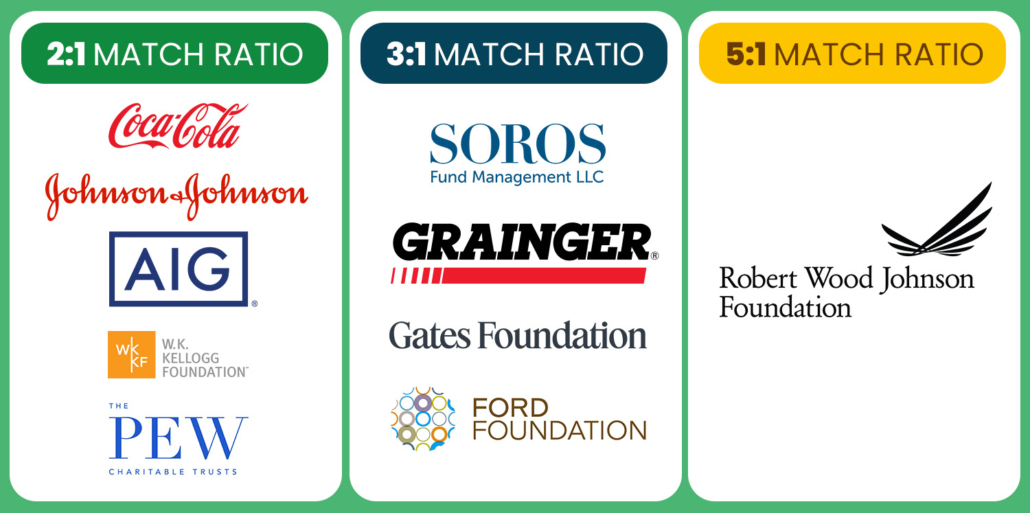
The 2:1 Vanguard (Tripling the Employee Donation)
Companies in the 2:1 vanguard have moved beyond the standard baseline to ensure that each dollar an employee gives results in two additional dollars from the corporate treasury (resulting in a total value 3x the initial donation amount!).
Currently, key leaders in the triple-match space include:
- Coca-Cola: Offering a 2:1 match for up to $10,000 per employee annually
- Johnson & Johnson: Providing a 2:1 match for current employees with a generous $20,000 annual cap
- American International Group (AIG): Maintaining a 2:1 ratio for community-based organizations and schools up to $10,000
- Pew Charitable Trusts: Matching team member donations 2:1 up to $20,000 per year
- W.K. Kellogg Foundation: Offering a 2:1 match, employee donations of up to $100,000 to most nonprofit causes are tripled
This level of support isn’t just a perk; it’s a central pillar of their corporate identity. By adopting a 2:1 ratio, employees feel more connected to their communities, and the company reinforces its reputation as a leader in philanthropic scale.
The 3:1 Visionaries (Quadrupling the Total Impact)
Stepping into 3:1 territory requires an even deeper level of corporate commitment and a willingness to let employee passion dictate significant capital allocation. Businesses operating at this level effectively quadruple the initial donation, providing $3 for every $1 a team member gives.
Notable companies leading the 4x impact movement include:
- Soros Fund Management: Combining a 3:1 ratio with a staggering $300,000 annual corporate contribution cap
- W.W. Grainger: Triple-matching employee gifts up to $2,500, resulting in a $7,500 corporate addition
- The Gates Foundation: A leader in global health giving, offering a 3:1 match up to $30,000
- Ford Foundation: Demonstrating a commitment to social justice by matching employee contributions at a 3:1 rate up to $30,000
The move to a 3:1 ratio represents a fundamental shift from “matching” to “investing.” For many of these employers, the multiplier serves as a recruitment tool for top-tier talent who are as driven by social equity as they are by professional success. This sends a clear message that the company trusts its employees’ giving enough to back it with three times the original investment, effectively turning every staff member into a mini-grantmaker for the causes they care about most.
The Outliers: A Standout 5:1 Match 🏆
The Robert Wood Johnson Foundation currently holds the record for the highest matching ratio at 5:1, essentially providing $5 for every $1 donated by a full-time or retired team member up to $50,000 each year.
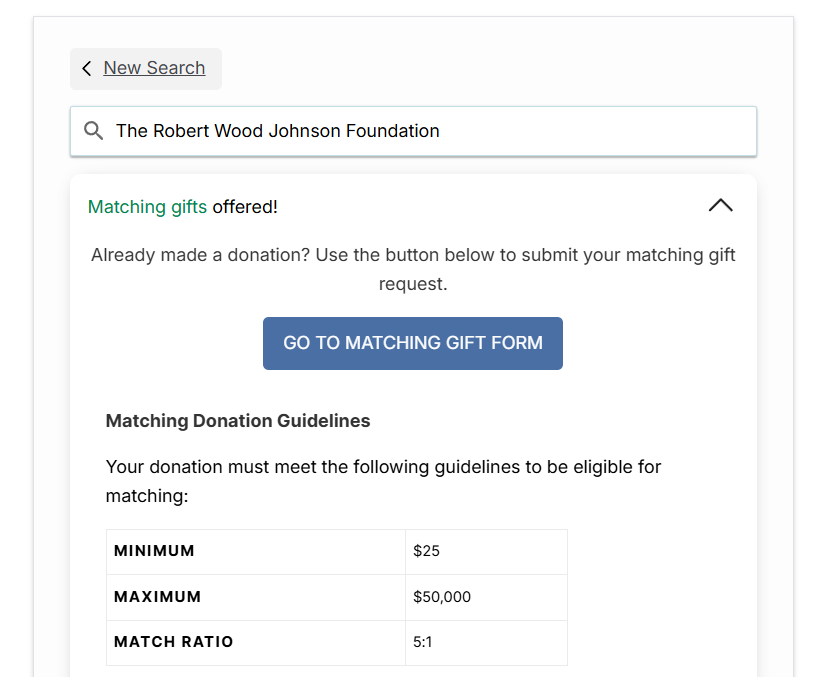
This example represents the pinnacle of multiplier-driven CSR and can serve as a powerful goal to work towards.
The Business Case for Higher Matching Gift Ratios
If you are a CSR leader or a C-suite executive, you might be asking yourself this: Why should we spend even more on matching gifts?
The answer lies in the tangible ROI of employee engagement and brand equity. Let’s take a closer look.
1. Increasing Talent Acquisition and Retention
The modern workforce (particularly Gen Z and Millennial staff) vets employers based on their social impact. A 1:1 match is now a baseline expectation. A 3:1 match, however, is a competitive advantage that’s more likely to attract and retain team members. It signals that the company is willing to put its capital behind its employees’ values at a rate that is three times the industry standard.
2. Improving Your Business Reputation
Modern consumers are increasingly voting with their wallets, gravitating toward brands that demonstrate a genuine commitment to social good. In fact, our CSR statistics indicate that individuals are “4-6x more likely to trust, protect, champion, and purchase from companies with a strong purpose.”
By increasing your matching gift ratio, you create a highly visible and authentic narrative of corporate generosity. Because these programs align with your employees’ passions, your company effectively supports a broad, diverse portfolio of causes. This organic diversity ensures that your brand’s philanthropic footprint aligns not only with your staff’s values but also with the wide-ranging preferences of your customer base.
3. Maximizing “Dead” Budget
Many companies allocate a specific budget for matching gifts that goes unused every year because of low employee awareness or participation. Instead of letting that budget sit idle, increasing the ratio helps ensure the allocated funds are actually deployed in the community.
In other words, it’s better to have 100 employees take advantage of a 3:1 match than to have 300 employees forgo a 1:1 match.
4. Deepening Nonprofit Partnerships
Nonprofits often prioritize their “high-ratio” donors. When your company offers a 2:1 or 3:1 match, your employees become VIPs at the organizations they support. This opens doors for deeper corporate partnerships, volunteer opportunities, and board placements, further cementing your company’s influence in the social sector.
5. Leveraging Strategic Tax Deduction Opportunities
Beyond the social benefits, increasing your matching gift multiplier can be a sound fiscal strategy, too. Under new regulations, many corporations are aiming to achieve specific charitable thresholds (now at least 1% of total funding) to maximize their ability to deduct charitable giving expenses.
Enhancing your match ratio is one of the most efficient ways to scale your corporate charitable spending without the administrative overhead of managing individual grants.
Strategic Multipliers: Using Ratios to Drive Specific Behaviors
One of the most exciting corporate giving trends we’re seeing is the use of variable match ratios or implementing higher multipliers to incentivize specific corporate goals. This allows a company to maintain a standard 1:1 program while supercharging the rates for particular causes or behaviors that align with its mission and goals.
Take a look at a few examples here:
| Company | Elevated Ratio | The “Unlock” Mechanism |
| American Express | 2:1 | Employee serves on a board or volunteers 50+ hours |
| Nike | 2:1 | Employee donations to sport-related causes or Black community initiatives |
| General Mills | 2:1 | Employee support for food sustainability-focused organizations |
| Caterpillar | 2:1 | Employee participation in promotional “Giving Tuesday” events |
| PNC Financial | Up to 4:1 | Employee’s title and leadership level within the company |
By using fluctuating matching gift ratios as a strategic lever, CSR managers can direct capital toward specific types of initiatives (such as DEI or environmental sustainability) without dictating which charity an employee can support. It preserves the “choice” element of workplace giving while maximizing the “impact” on core corporate values.
How to Transition Your Match Program to a Multiplier Model
Transitioning from a 1:1 ratio to a high-multiplier model doesn’t need to happen overnight. However, we do recommend it as an ideal benchmark for any program aspiring to maximize its impact.
Here’s a helpful roadmap for CSR departments looking to evolve (and stay ahead of the curve!):
Step 1: Consider the “Themed” Multiplier
Start by offering a 2:1 match for a specific month related to your cause (such as Earth Month) or a specific event (like Giving Tuesday). Doing so empowers your company to test the budgetary impact and see how participation rates spike when the multiplier is introduced.
Step 2: Reward Deeper Engagement
Follow the lead of American Express. Consider offering a 1:1 match for general donations, but offer an “unlockable” 2:1 or 3:1 match for employees who also log a certain number of volunteer hours or serve on a nonprofit’s board of directors. This creates a holistic culture of “Time + Treasure = Increased Impact.”
Step 3: Ensure Cap Management
If you’re concerned about “runaway costs,” don’t lower the ratio; adjust the cap. It is often more impactful to offer a 3:1 match with a $5,000 cap than a 1:1 match with a $15,000 cap.
The higher ratio drives more excitement, even if the total potential liability for the company remains the same.
Step 4: Leverage Technology
You might worry that an expanded matching gift program will require more time and resources from your team. But with the right technology powering your efforts, that’s simply not the case!
Implementing robust CSR software makes it quick and easy to manage matching gifts. Plus, it makes it even simpler for your employees to participate using intuitive online submission processes rather than requiring them to download, print, and even mail their forms.
Step 5: Market Your “New-and-Improved” Program
The biggest barrier to matching gift success is program awareness. And unfortunately, a high ratio is only as effective as the participation it generates. Employees can’t take advantage of a 3:1 match if they don’t know it exists!
Once you’ve increased your multipliers, launch a targeted internal marketing campaign to ensure your employees understand the new, amplified power of their contributions. Use internal newsletters, Slack channels, and town hall meetings to communicate the change. Then, ensure your updated program guidelines are reflected within Double the Donation’s matching gift database. Because this tool is integrated directly into the donation forms of thousands of nonprofits, your employees will see your expanded guidelines the moment they make a gift.

Wrapping Up: Looking to the Future of CSR
As we look toward 2030 and beyond, the “Matching Gift” will likely evolve into something even more integrated. The companies that win the “War for Talent” and the “Race for Impact” are those that stop viewing philanthropy as a cost center and start viewing it as a force multiplier.
A dollar is just a dollar. But a 3:1 match is a statement of purpose, a boost in employee morale, and a significant win for a nonprofit in need. It’s time for the corporate world to do the math and recognize that when it comes to social impact, the multiplier effect is the way forward.
Make matching gifts easier with a complete CSR management solution! Contact us here, and we’ll get in touch with information about our recommended platforms.

