Maximize Prospect Research With Employer Data Strategies
Modern corporate fundraising requires moving beyond traditional wealth screening to analyze supporters’ full potential. By conducting employer data enrichment, development teams can uncover high-value workplace giving opportunities hidden within their existing networks to maximize prospect research and scale sustainable revenue.
For decades, conventional fundraising intelligence relied heavily on wealth indicators like real estate holdings, luxury assets, and historical giving patterns to identify high-value prospects. While these metrics offer a useful baseline, they capture only a fraction of a donor’s total philanthropic capacity, frequently leaving institutional dollars completely undetected.
Forward-thinking strategies go beyond these narrow boundaries by evaluating the total corporate footprint of your supporter base.
When an organization integrates workplace affiliation tracking into its standard matrix, it shifts the focus from individual donations to collective influence. Evaluating a donor’s professional ecosystem enables each team to build a comprehensive analysis that accounts for workplace giving.
In this guide, we’ll cover:
- The role of employer information in successful prospect research
- Actionable strategies to maximize prospect research outcomes
- 4 ways to leverage employment information in prospect research
- Top tools to maximize prospect research with employment insights
Knowing where supporters work empowers organizations to focus their resources where they’re likely to have the greatest possible impact. By transforming raw employment data into actionable supporter profiles, nonprofits can systematically approach corporate partnerships with concrete employee backing already secured.
Quick Note: This guide focuses on advanced prospect research strategies for nonprofits and schools aiming to grow their fundraising and workplace giving revenue. Looking for an introductory guide? Check out our recommendations for kicking off your prospect research strategy here.
The Role of Employer Information in Successful Prospect Research
When it comes to maximizing the benefits of prospect research, understanding individual capacity is only half the battle. To truly make the most of the information at their fingertips, progressive development teams must map the professional ecosystems surrounding their supporters.
Employer data enrichment bridges the gap between basic records and actionable corporate intelligence. By systematically identifying where your donors and volunteers work, your organization can move beyond guesswork and uncover new, powerful funding channels.
What is employer data enrichment?
Data enrichment is the process of automatically combining external insights into your existing database to establish complete and actionable profiles of your supporters.
Employer data enrichment refers specifically to gathering employment-related information (such as industry, company, and job title) about donors and volunteers, often with a goal of uncovering available workplace giving programs.
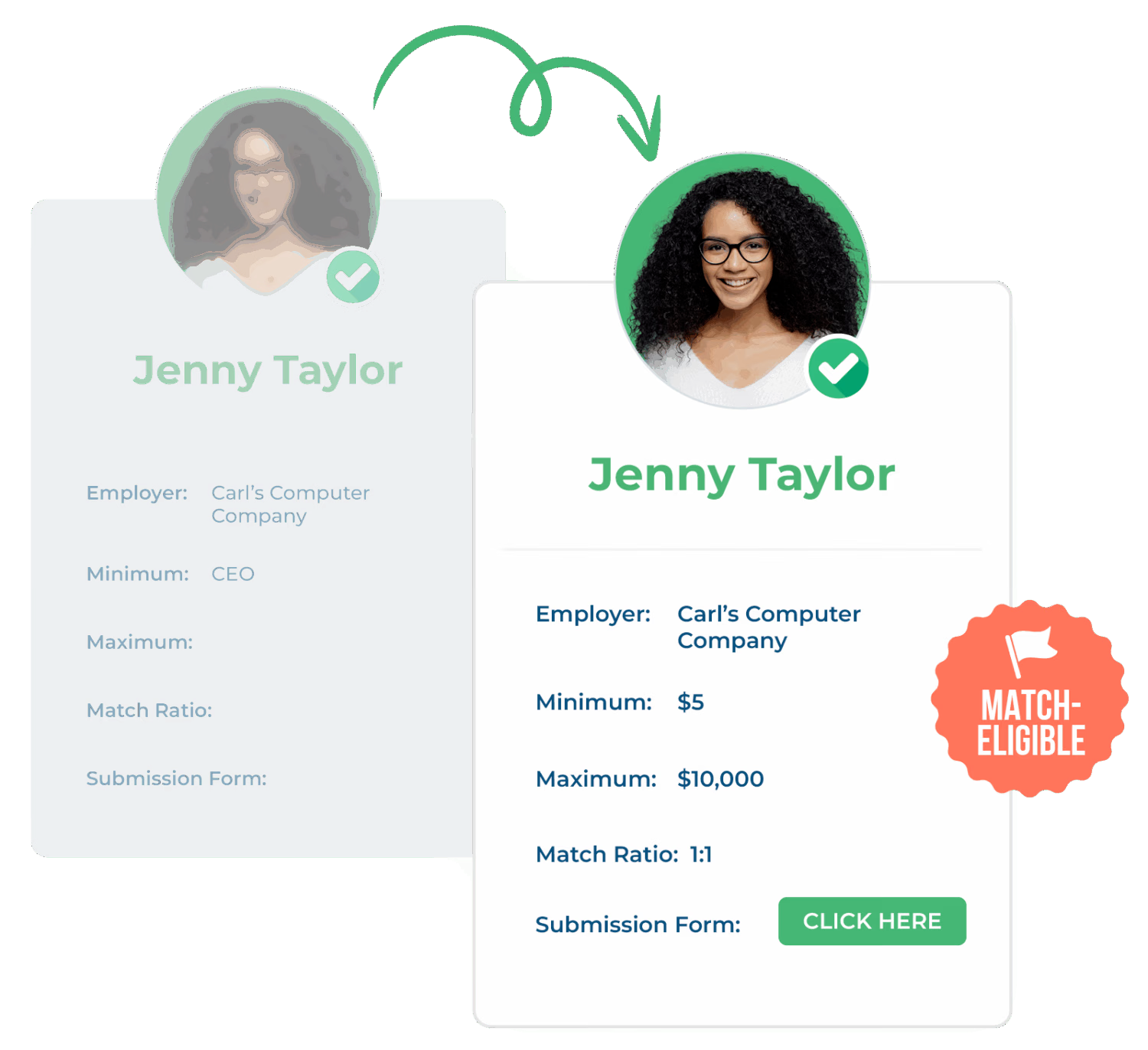
This strategy involves cross-referencing supporter details with verified employment registries to link individual donor files to their real-world employers. It transforms an isolated name into a corporate-affiliated contact record with measurable philanthropic potential.
Key benefits include:
- Organizational time-saving — Fundraisers spend less time conducting manual research, freeing up valuable hours for direct outreach and high-level campaign design.
- Improved campaign segmentation — Teams can group donors by their specific corporate match parameters, ensuring that high-yield employee groups receive targeted marketing communications designed to promote this benefit.
- Smoother supporter journeys — Donors and volunteers receive relevant communications that align with their specific programming, preventing the frustration of receiving generic, inapplicable outreach.
For a highly strategic database audit, prioritize enrichment cycles immediately before your annual giving day. Appending fresh employer data leading up to a high-volume campaign allows your marketing team to inject real-time corporate match reminders into your automated sequences, instantly elevating donation values.
Actionable Strategies to Maximize Prospect Research Outcomes
To transform passive data into active revenue, organizations must implement structured methodologies that extract value from employer records. Relying solely on standard donor profiles limits your team’s foresight and leaves thousands of dollars in institutional funds on the table.
Check out our recommended tips:
Build a corporate data roadmap.
Integrate corporate match limits, volunteer program guidelines, and payroll deduction rules directly into supporter profiles. By mapping the corporate policies of businesses present in your network across your donor database, you can provide your development team with clear talking points during key donor conversations. This structured approach ensures that no institutional intelligence (or funding) is lost when individual staff members transition out of the organization.
Screen for matching gift capacity.
Use employer insights to find major gift prospects who can double their impact through corporate matching. This strategy reveals mid-level donors who may have the hidden capacity to enter major-giving brackets once their employer’s funds are factored into their total value.
Gift officers can then prioritize prospects who work for companies with high-ratio matching gift programs or lofty annual thresholds (such as Soros Fund Management’s $100,000 limit!), maximizing the return on development outreach.
Pinpoint corporate giving hubs.
Look for concentrations of donors or volunteers who share the same employer to find hidden organizational connections. These hubs show you exactly where to focus your corporate partnership efforts, indicating which local or national businesses already have an affinity for your mission, as reflected in their employees’ behavior.
Uncovering a cluster of 20 employees at a single firm provides your corporate relations team with immediate leverage to pursue deeper partnership requests.
When identifying giving hubs, don’t limit your focus to Fortune 500 giants. Mid-sized local businesses may exhibit higher internal density among your regional donor base. Targeting these localized employee clusters can lead to exclusive sponsorships or corporate board placements that a distant multinational corporation would rarely offer.
Regularly refresh employment information.
Without consistent maintenance protocols, employer records grow obsolete, causing your outreach to lose relevance and precision. Therefore, organizations should collect employment data from supporters each time they engage, whether that’s through a donation form or a volunteer registration.
If you’ve opted to work with an employer append service to fill in the remaining gaps, the process should be completed regularly (such as annually) so that you’re not operating on outdated insights.
Train your internal fundraising staff.
Make sure your development team understands how to clearly communicate corporate giving opportunities across all giving channels. Frontline fundraisers, major gift officers, and annual fund managers must be fully aligned on how to introduce workplace philanthropy opportunities in standard donor conversations. Meanwhile, regular cross-training workshops and other internal marketing efforts ensure that administrative staff can respond to basic inquiries related to employee giving.
Track key performance indicators.
Monitor your total matching gift revenue and volunteer grant completions to evaluate and enhance your strategy. Establish a central dashboard to track match submission rates, average corporate gift sizes, and corporate payout timelines, identifying potential bottlenecks in your follow-up pipeline. These operational metrics provide the data required to justify ongoing investments to your leadership.
4 Ways to Leverage Employment Data in Prospect Research
Business influence extends far beyond a company’s direct treasury allocations. When an organization tracks employer details, it unlocks the collective power of a corporate workforce to amplify fundraising outreach.
Leveraging this professional network allows development teams to turn everyday supporters into internal advocates who champion your mission within their corporate boardrooms.
1) Uncovering workplace giving potential
Employer data helps you see which individuals can use workplace giving programs to amplify their support. Instead of asking for a larger out-of-pocket contribution, simply show a donor or volunteer how their existing workplace framework naturally amplifies their commitment. This shifts the focus of the conversation from personal financial sacrifice to corporate optimization.
Workplace giving includes…
- Matching gift programs: Companies match employee donations dollar-for-dollar, or sometimes double or triple the initial amount, up to a specified ceiling.
- Volunteer rewards: Businesses award paid time off for volunteering, often offering monetary grants to eligible nonprofits based on the number of hours an employee volunteers at that organization.
- Payroll systems: Corporate employees authorize automatic, pre-tax deductions from their paychecks to be distributed directly to verified charitable groups throughout the calendar year.
These initiatives can go a long way in terms of driving revenue and engagement alike. But you won’t know which programs your supporters qualify for (and therefore won’t be able to promote the opportunities) if you don’t know where they work!
2) Removing friction from the supporter journey
Workplace giving automation, powered by up-to-date employment information, gives donors and volunteers immediate access to corporate submission links during the transaction process. To maximize participation, position a company search tool directly on your confirmation page. Capturing the donor’s attention while their philanthropic commitment is at its peak ensures a much higher completion rate for corporate giving applications.
3) Rallying to get colleagues involved
Encourage highly engaged donors to serve as workplace champions within their respective offices. Individuals can establish corporate volunteer teams or organize matching gift drives among their coworkers, thereby scaling your nonprofit’s peer-to-peer fundraising reach.
These internal advocates turn an ordinary corporate office into an active engine for growth.
4) Inspiring donors to start new corporate programs
When you spot a hub of donors at a business without an official giving program, use that insight to help those supporters pitch a new workplace giving opportunity to their HR or corporate leadership teams.
Providing enthusiastic employees with a structured way to make an impact in their workplace empowers them to advocate for matching gift opportunities within their own companies, such as by facilitating a warm introduction between your team and their employer or pitching a matching gift partnership themselves. Such grassroots employee championing frequently bypasses the traditional corporate gatekeepers who often reject cold nonprofit requests.
Top Tools to Maximize Prospect Research With Employment Insights
Uncovering where your supporters work (in an effective and efficient manner) generally requires specialized prospect research tools and technical workplace giving data platforms. Designed to process vast corporate databases and map insights directly to your existing records, these modern fundraising solutions can instantly identify opportunities within your reach.
Let’s review the two top providers.
#1: Double the Donation’s Workplace Fundraising Platform
Double the Donation provides an end-to-end infrastructure that allows nonprofits to seamlessly collect, analyze, and act on employment data throughout the entire supporter lifecycle. Rather than treating employer tracking as a static database attribute, the platform integrates directly into donation forms, confirmation pages, and volunteer registrations to gather corporate affiliations in real time.
For organizations looking to update their historical databases, Double the Donation also offers dedicated employer data enrichment services to fill the remaining gaps. This empowers nonprofits and schools to supplement donor-provided information at scale, surfacing even more corporate support programs.
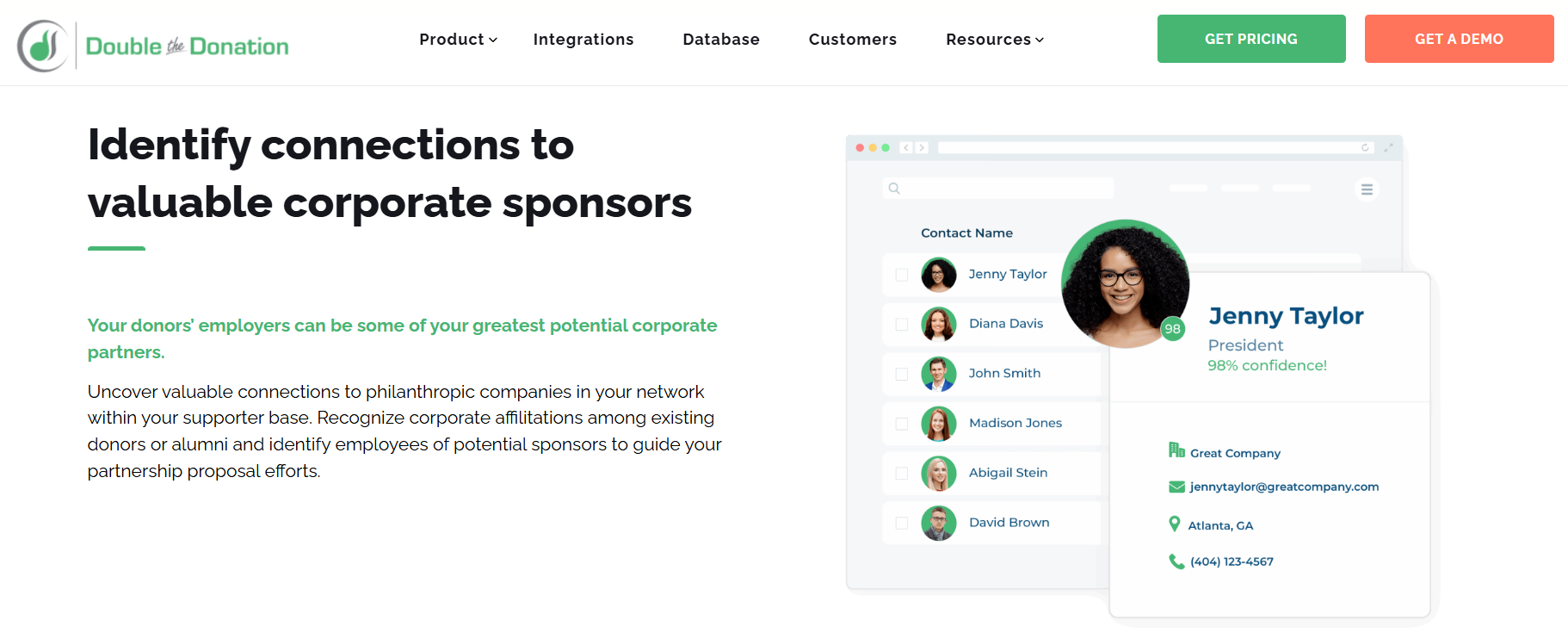
Once collected, the data triggers automated workflows that guide donors through matching gift submissions, volunteer grant logging, and payroll deduction enrollment based on their employer’s specific guidelines.
See how you can enhance your prospect research with Double the Donation.
#2: NPO Info’s Data Appending Services
NPO Info operates as a traditional, standalone data enrichment service designed to assist nonprofits with backend database hygiene and retrospective screening. Organizations simply submit their existing donor files to the platform, which then uses proprietary data registries to append missing information. This batch-processing model serves as a passive prospect research tool, helping gift officers segment their lists by industry or employer.
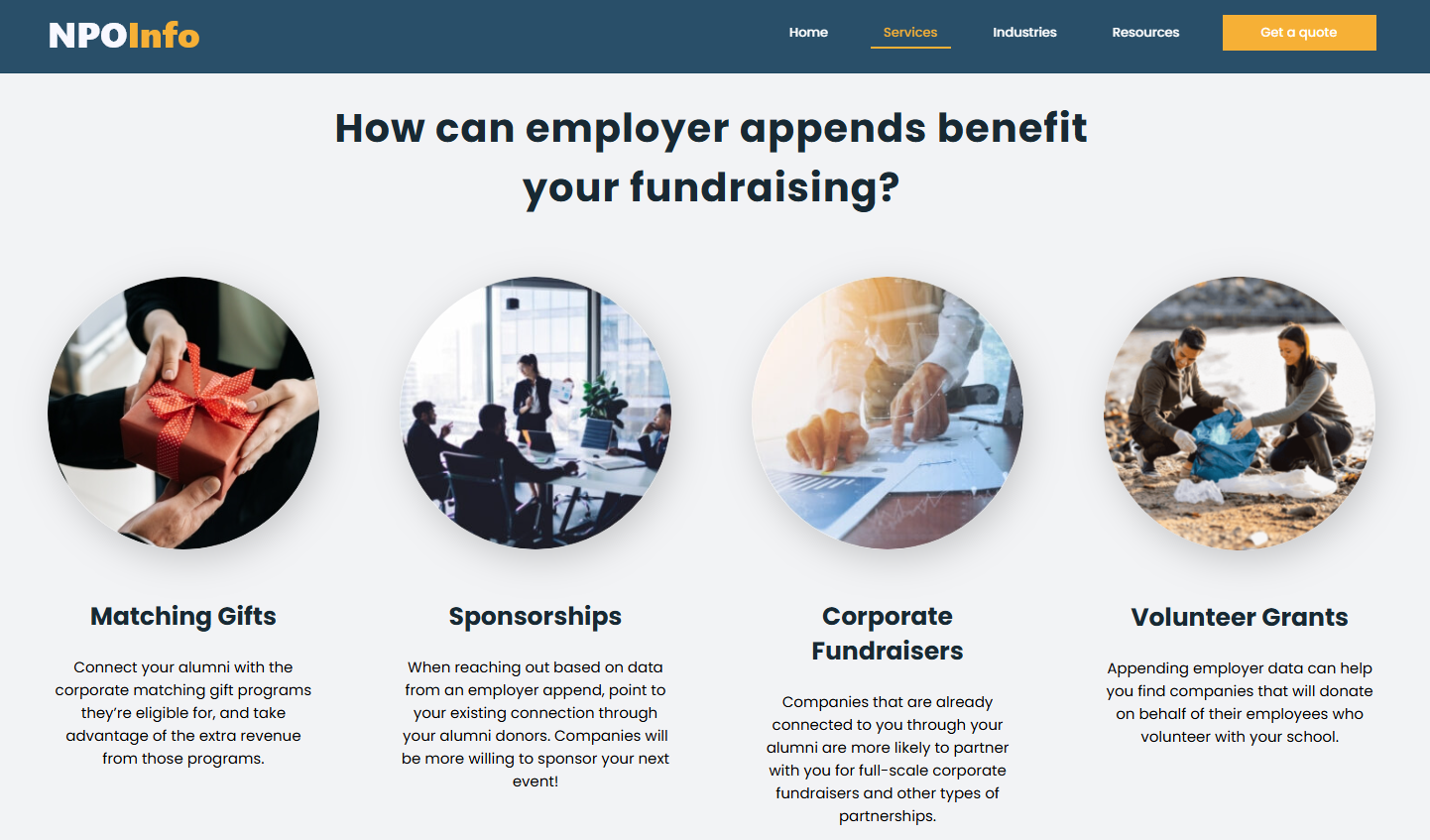
While useful for basic profiling, NPO Info is not as comprehensive nor as accurate as Double the Donation, particularly when mapping supporters to workplace giving eligibility. NPO Info provides raw employment records, but leaves development teams with the administrative burden of researching matching gift policies, tracking volunteer grant eligibility, or otherwise converting appended employer names into realized corporate funding streams.
Learn more about NPO Info’s employer append services.
Final Thoughts & Next Steps
Aligning data with fundraising goals changes how nonprofits view donor capacity, shifting from individual wealth indicators to comprehensive corporate networks. This employer-centric lens makes your outreach increasingly efficient, maximizing the return on investment for every campaign you launch.
Taking action with dedicated workplace giving software saves organizations significant time while unlocking sustainable revenue that powers growth.
Ready to get started? Establish a process for regularly collecting employment information from your donors and volunteers. Then, use that data to tailor your corporate fundraising outreach and convert newly discovered giving hubs into long-term collaborative partnerships.
For more information on maximizing prospect research with employment data, check out these additional resources:
- Fundraising Intelligence: Capture + Leverage the Right Donor Data. An intelligent fundraising strategy should center on the insights you surface through engagement, appending, and more. Having the right data makes a big difference!
- The Value of Donor Employment Information in Workplace Giving. Proactively gathering employment info can go a long way in driving corporate fundraising success. Learn how you can use this data to increase workplace giving revenue here.
- Top 50 Companies With Standout Workplace Giving Programs. Once you know where your supporters work, find out if they qualify for generous workplace giving initiatives! This directory of leading programs is a great start.